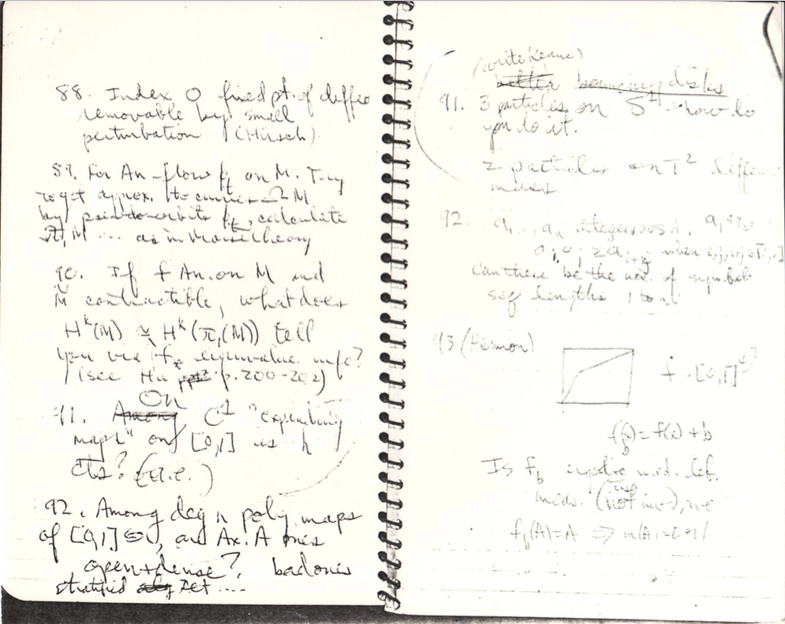
Herman or Henon? Seems that he is asking if $f_b$ is ergodic with respect to
Lebesgue measure, in the sense that $f_b(A) = A$ implies that $A$ has measure
0 or 1.
Ledrappier (2016-11-14 17:11:40 -0800 -0800):
Hardly legible. Seems related to a result of M. Herman (in
[herman1979conjugaison]
?) about ergodicity in families $f_b = f +b$, for $f$
homeomorphism of the circle.
Anthonyquas (2016-12-01 22:15:11 -0800 -0800):
So is the question: “Let $f$ be a homeomorphism of the circle (maybe a
specific two-slope example). For each $b$, define $f_b(x)=f(x)+b$. Say that
$f_b$ is ergodic with respect to Lebesgue if $f_b(A)=A$ implies $A$ has
measure 0 or 1 (no assumption of invariance of Lebesgue measure here). For a
fixed $f$, what can be said about the set of $b$ such that $f_b$ is ergodic?”
Comments
Herman or Henon? Seems that he is asking if $f_b$ is ergodic with respect to Lebesgue measure, in the sense that $f_b(A) = A$ implies that $A$ has measure 0 or 1.
Hardly legible. Seems related to a result of M. Herman (in [herman1979conjugaison] ?) about ergodicity in families $f_b = f +b$, for $f$ homeomorphism of the circle.
So is the question: “Let $f$ be a homeomorphism of the circle (maybe a specific two-slope example). For each $b$, define $f_b(x)=f(x)+b$. Say that $f_b$ is ergodic with respect to Lebesgue if $f_b(A)=A$ implies $A$ has measure 0 or 1 (no assumption of invariance of Lebesgue measure here). For a fixed $f$, what can be said about the set of $b$ such that $f_b$ is ergodic?”