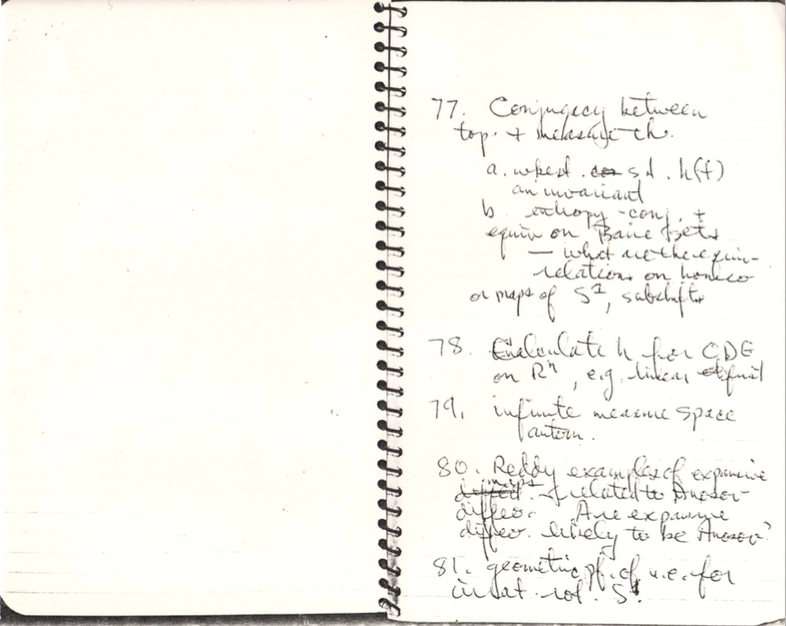
Conjugacy between topology and measure theory a. Weakest notion such that h(f)
is an invariant b. Entropy-conjugacy + equivalence on Baire sets; what are the
equivalence relations on homeomorphisms or maps on $S^1$ and subshifts?
Various versions of conjugacy between topology and measure theory'' have been studied in the case of a mixing shift of finite type $S$ with a specified invariant Markov measure $\mu$. At one extreme, a conjugacy $\phi: (S,\mu ) \to (S,\mu')$ is only required to satisfy $\phi_* (\mu ) = \mu'$ with $\phi S = S'\phi$ on a set of full $\mu$ measure. At the other extreme, $\phi$ is also required to be a homeomorphism. Intermediate requirements on $\phi$ were studied by Keane and Smorodinsky, Parry, Schmidt, Marcus and Tuncel, Gomez ... For a brief review of this with references, and the still-open Good finitary
conjecture’’, see the discussion of Problem 9 in
[Boyle2008open]
(also available as ``OPSD’’ at http://www.math.umd.edu/~mboyle/open/ ).In
another direction, one can consider homeomorphisms $S$ and $S'$ with respect
to all invariant Borel probabilities (not just one), and ask for a topological
or Borel conjugacy between the complements of sets of measure zero for all
nonatomic invariant Borel probabilities. Hochman
[hochman2013full]
proved striking universality results in this direction (for application of
this work to $C^+$ diffeomorphisms, see
[boyle2014almost]
,
[buzzi2015almost]
).Finally, following Shelah and Weiss, one can consider $S$
and $S'$ as Borel systems, neglecting wandering sets; see
[hochman2015borel]
for dramatic progress on this long stalled study.
Comments
I understand: Notions of similarity intermediate between topological conjugacy and measurable isomorphism a.e.. right?
Entropy-conjugacy refers to Bowen’s paper [bowen1973topological] . See [boyle2014almost] for recent work. See Problem 99
Various versions of
conjugacy between topology and measure theory'' have been studied in the case of a mixing shift of finite type $S$ with a specified invariant Markov measure $\mu$. At one extreme, a conjugacy $\phi: (S,\mu ) \to (S,\mu')$ is only required to satisfy $\phi_* (\mu ) = \mu'$ with $\phi S = S'\phi$ on a set of full $\mu$ measure. At the other extreme, $\phi$ is also required to be a homeomorphism. Intermediate requirements on $\phi$ were studied by Keane and Smorodinsky, Parry, Schmidt, Marcus and Tuncel, Gomez ... For a brief review of this with references, and the still-openGood finitary conjecture’’, see the discussion of Problem 9 in [Boyle2008open] (also available as ``OPSD’’ at http://www.math.umd.edu/~mboyle/open/ ).In another direction, one can consider homeomorphisms $S$ and $S'$ with respect to all invariant Borel probabilities (not just one), and ask for a topological or Borel conjugacy between the complements of sets of measure zero for all nonatomic invariant Borel probabilities. Hochman [hochman2013full] proved striking universality results in this direction (for application of this work to $C^+$ diffeomorphisms, see [boyle2014almost] , [buzzi2015almost] ).Finally, following Shelah and Weiss, one can consider $S$ and $S'$ as Borel systems, neglecting wandering sets; see [hochman2015borel] for dramatic progress on this long stalled study.