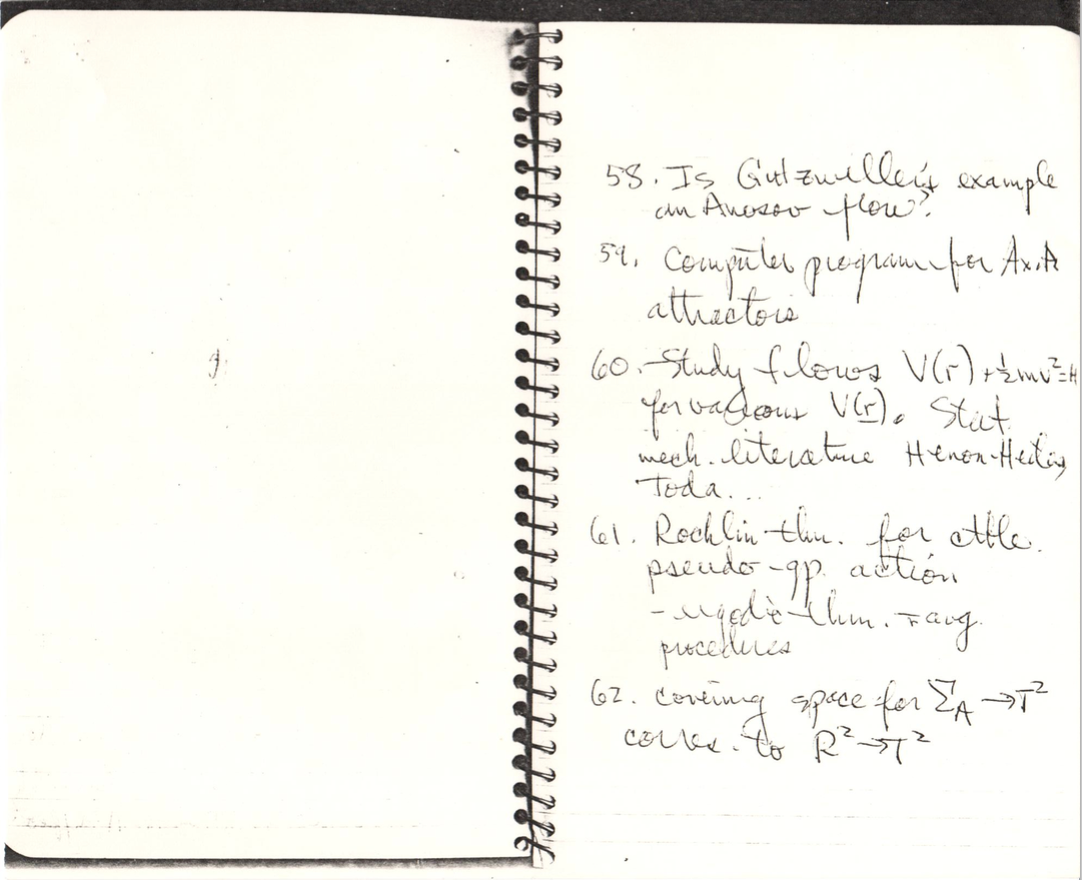
Maybe $\Sigma_A$ means a 2-dimensional solenoid, and then he is asking about
generalizations of the Smale attractor?
Mike Boyle (2017-07-06 20:55:33 -0700 -0700):
Often $\Sigma_A$ refers to a shift of finite type defined by a matrix $A$.
Perhaps then $\pi: \Sigma_A \to \mathbb T^2$ is a factor map from a mixing
shift of finite type onto a hyperbolic toral automorphism derived from some
Markov partition. Then he would be asking for something analogous to the
universal cover $p: \mathbb{R}^2 \to \mathbb T^2$. A natural candidate would
be the fiber product of $\pi$ and $p$, perhaps restricted to a suitable
subsystem. But, for what problem is this useful …
Comments
don’t see what that means…
Maybe $\Sigma_A$ means a 2-dimensional solenoid, and then he is asking about generalizations of the Smale attractor?
Often $\Sigma_A$ refers to a shift of finite type defined by a matrix $A$. Perhaps then $\pi: \Sigma_A \to \mathbb T^2$ is a factor map from a mixing shift of finite type onto a hyperbolic toral automorphism derived from some Markov partition. Then he would be asking for something analogous to the universal cover $p: \mathbb{R}^2 \to \mathbb T^2$. A natural candidate would be the fiber product of $\pi$ and $p$, perhaps restricted to a suitable subsystem. But, for what problem is this useful …