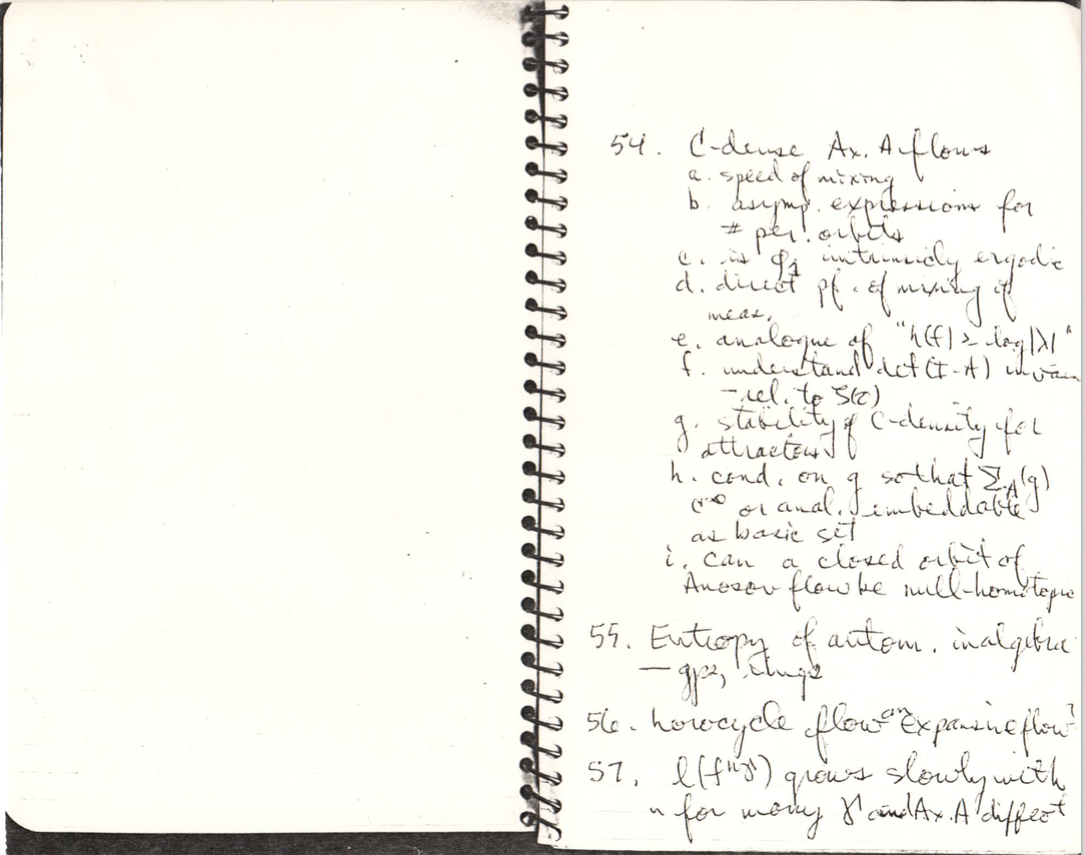
The horocycle flow of a closed (compact without boundary) hyperbolic surface
is not expansive. This follows from the development of the theory of expansive
homeomorphisms of surfaces and nonsingular expansive flows of three
dimensional manifolds, Let me explain briefly. By the end of the 1980’s J.
Lewowicz (Expansive homeomorphisms of surfaces, Bol. Soc. Brasil. Mat., 20
(1989), 113-133 and K. Hiraide (Expansive homeomorphisms of compact surfaces
are pseudo-Anosov, Osaka J. Math., 27 (1990), 117-162) showed that expansive
homeomorphisms of closed surfaces have local stable and unstable sets with a
local product structure at every point but at a finite number of periodic
orbits, where invariant sets have a prone singularity structure. This
remarkable result implies that every expansive homeomorphism acting on a
closed surface is topologically conjugate to a pseudo Anosov map. The
existence of invariant sets with local product structure at every point but at
a finite set of singular periodic orbits was extended to nonsingular expansive
flows acting on closed three manifolds by M. Paternain (Expansive flows and
the fundamental group, Bol. Soc. Bras. Mat. 24 (1993) 179-199) and T. Inaba-
S. Matsumoto (Nonsingular expansive flows on three manifolds and foliations
with circle prone singularites, Japan. J. Math. Vol. 16, No. 2, 1990). The
existence of local invariant sets with local product structure in the Anosov
case has many strong consequences of course. Concerning periodic orbits, local
product structure implies for instance that an Anosov flow of a closed three
manifold with a dense set of recurrent orbits has a dense set of periodic
orbits. The same fact holds for expansive geodesic flows of closed surfaces by
the above reference by M. Paternain together with R. Ruggiero (Persistently
expansive geodesic flows, Comm. Math. Phys. 140, Number 1 (1991), 203-215).
The horocycle flow is a nonsingular, minimal flow acting on the unit tangent
bundle of a hyperbolic surface by a celebrated work of G. Hedlund (Fuchsian
groups and transitive horocycles. Duke Math. J. 2 (1936) 530-542)..So if it
was expansive then it would have invariant sets with local product structure
at every point but at a finite set of periodic orbits whenever the surface is
closed. Since there are no periodic orbits there would be a local product
structure at every point, and since every orbit is dense it is in particular
recurrent. So the horocycle flow would have a dense set of periodic orbits by
the same argument applied in " Persistently expansive geodesic flows, Comm.
Math. Phys. 140, 1 (1991) 203-215" which is impossible. The horocycle flow
exists on the unit tangent bundle of every surface without conjugate points.
If the surface is the torus or the Klein bottle then the surface is flat by
the famous work of E. Hopf, so the horocycle flow is obviously nonexpansive.
If the genus of the surface is greater than one the argument for hyperbolic
surfaces extends without changes since by the work of P. Eberlein the
horocycle flow of a closed surface without conjugate points and genus greater
than one is minimal (Horocycle flows on certain surfaces without conjugate
points. Trans. Amer. Math. Soc. 233 (1977) 1-36).
Comments
The horocycle flow of a closed (compact without boundary) hyperbolic surface is not expansive. This follows from the development of the theory of expansive homeomorphisms of surfaces and nonsingular expansive flows of three dimensional manifolds, Let me explain briefly. By the end of the 1980’s J. Lewowicz (Expansive homeomorphisms of surfaces, Bol. Soc. Brasil. Mat., 20 (1989), 113-133 and K. Hiraide (Expansive homeomorphisms of compact surfaces are pseudo-Anosov, Osaka J. Math., 27 (1990), 117-162) showed that expansive homeomorphisms of closed surfaces have local stable and unstable sets with a local product structure at every point but at a finite number of periodic orbits, where invariant sets have a prone singularity structure. This remarkable result implies that every expansive homeomorphism acting on a closed surface is topologically conjugate to a pseudo Anosov map. The existence of invariant sets with local product structure at every point but at a finite set of singular periodic orbits was extended to nonsingular expansive flows acting on closed three manifolds by M. Paternain (Expansive flows and the fundamental group, Bol. Soc. Bras. Mat. 24 (1993) 179-199) and T. Inaba- S. Matsumoto (Nonsingular expansive flows on three manifolds and foliations with circle prone singularites, Japan. J. Math. Vol. 16, No. 2, 1990). The existence of local invariant sets with local product structure in the Anosov case has many strong consequences of course. Concerning periodic orbits, local product structure implies for instance that an Anosov flow of a closed three manifold with a dense set of recurrent orbits has a dense set of periodic orbits. The same fact holds for expansive geodesic flows of closed surfaces by the above reference by M. Paternain together with R. Ruggiero (Persistently expansive geodesic flows, Comm. Math. Phys. 140, Number 1 (1991), 203-215). The horocycle flow is a nonsingular, minimal flow acting on the unit tangent bundle of a hyperbolic surface by a celebrated work of G. Hedlund (Fuchsian groups and transitive horocycles. Duke Math. J. 2 (1936) 530-542)..So if it was expansive then it would have invariant sets with local product structure at every point but at a finite set of periodic orbits whenever the surface is closed. Since there are no periodic orbits there would be a local product structure at every point, and since every orbit is dense it is in particular recurrent. So the horocycle flow would have a dense set of periodic orbits by the same argument applied in " Persistently expansive geodesic flows, Comm. Math. Phys. 140, 1 (1991) 203-215" which is impossible. The horocycle flow exists on the unit tangent bundle of every surface without conjugate points. If the surface is the torus or the Klein bottle then the surface is flat by the famous work of E. Hopf, so the horocycle flow is obviously nonexpansive. If the genus of the surface is greater than one the argument for hyperbolic surfaces extends without changes since by the work of P. Eberlein the horocycle flow of a closed surface without conjugate points and genus greater than one is minimal (Horocycle flows on certain surfaces without conjugate points. Trans. Amer. Math. Soc. 233 (1977) 1-36).