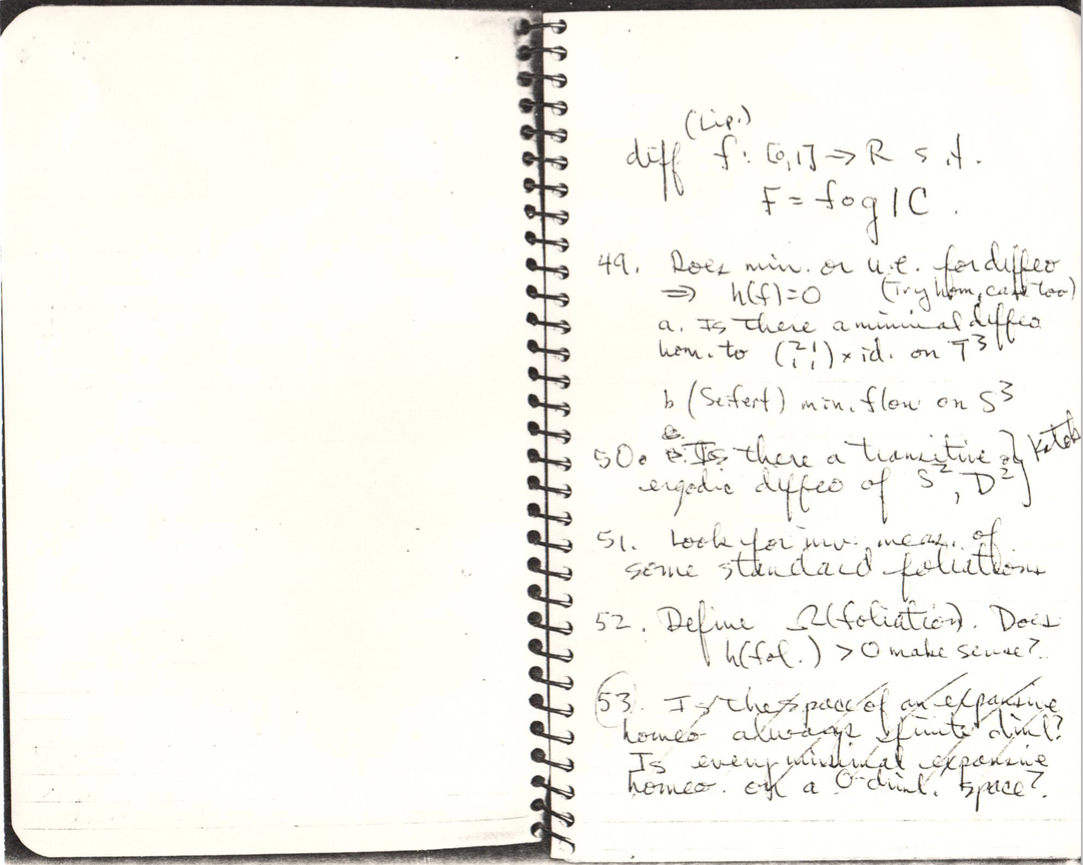
I am a bit surprised by this question because I think the answer was known at
that time. Following the work of Plykin, we can start from an hyperbolic toral
automorphism and map the torus to the sphere using a Jacobi elliptic function.
The result is a pseudo-Anosov diffeomorphism of the sphere that inherits the
properties of the toral automorphism with respect to a measure absolutely
continuous with respect to Lebesgue. Then we can project the sphere on the
plane stereographically and send the plane in a disk. Actually the procedure
goes back to Schroeder (1871) when starting from multiplication by 2 on a
2-dimensional torus, and gives a transitive rational transformation of the
Riemann sphere. Or do I miss something?
Comments
See [katok1970new] , [fayad2004constructions] for a 2004 survey.
I am a bit surprised by this question because I think the answer was known at that time. Following the work of Plykin, we can start from an hyperbolic toral automorphism and map the torus to the sphere using a Jacobi elliptic function. The result is a pseudo-Anosov diffeomorphism of the sphere that inherits the properties of the toral automorphism with respect to a measure absolutely continuous with respect to Lebesgue. Then we can project the sphere on the plane stereographically and send the plane in a disk. Actually the procedure goes back to Schroeder (1871) when starting from multiplication by 2 on a 2-dimensional torus, and gives a transitive rational transformation of the Riemann sphere. Or do I miss something?