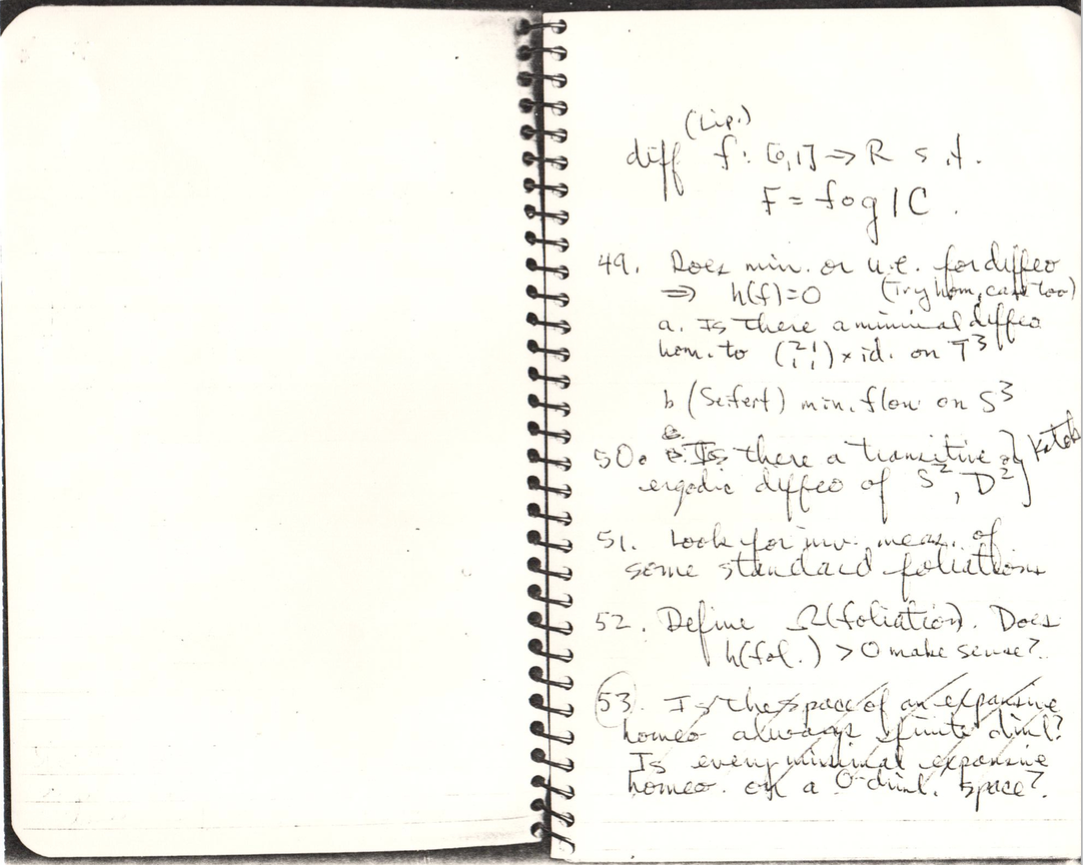
Problem 49
Does minimal or uniquely ergodic for a diffeo $f$ implies $h(f) = 0$ (try homeo case too)? Is there a minimal diffeo homotopic to $\left( \begin{matrix} 2 & 1\\\ 1& 1 \end{matrix} \right) \times Id. $ on $\mathbb T^3$? (Seifert conjecture) Minimal flow on $\mathbb S^3$.
Comments
For b: [kuperberg1994smooth] , [kuperberg1996volume] .
The Seifert conjecture asked if every non-singular flow on S3 has a periodic orbit. The answer is no by K. Kuperberg’s construction. The existence of a minimal flow on S3 is Gottschalk’s conjecture and it is still an open problem.
For the first question, there are uniquely ergodic homeomorphisms of T^2 with positive entropy (https://arxiv.org/PS_cache/math/pdf/0605/0605438v1.pdf) and minimal analytic diffeomorphisms with positive entropy in dimension 4 (https://www.cambridge.org/core/journals/ergodic-theory-and-dynamical- systems/article/div-classtitleconstruction-dandaposun-diffeomorphisme-minimal- dandaposentropie-topologique-non-nullediv/5A88014D24F6C4CF8E114A3EFA13B920). For a), Franks’ semiconjugacy gives a negative answer: Take $F$ homotopic to $(2111)\times id$ and a lift of $\hat F$ to $R^2 x R.$ If $\\{(x_n,t_n)\\}$ is an $\hat F$ orbit, then $\\{x_n\\}$, its projection to $R^2$ is a bounded pseudo-orbit for the linear map $(2111)$ acting on $R^2$. Therefore, there is a unique orbit $\\{y_n\\}$ of $(2111)$ that shadows this pseudo-orbit. The map $x_0 \mapsto y_0$ is continuous, equivariant and bounded distance from the projection (therefore surjective). This is Franks’ semiconjugacy which descends to a map $h: T^2 \times S^1 \to T^2$. Now, the preimage of a fixed (or periodic) orbit of $(2111)$ in $T^2$ will give a closed invariant subset contradicting minimality.