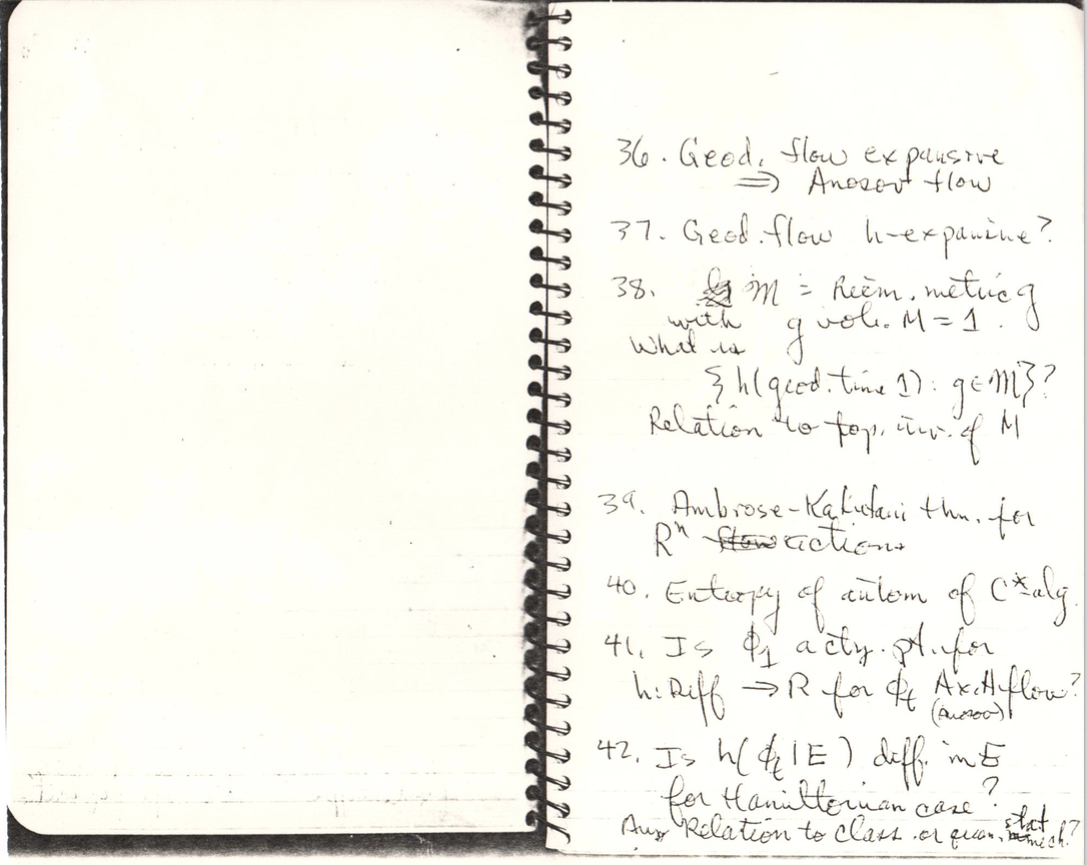
In [1] and [2], Ambrose and Kakutani showed that every measure-preserving
(m.p.) action of $\mathbb{R}$ can be represented as a suspension flow over a
finite m.p. transformation. Wagh [3] carried out an analogue of the Ambrose-
Kakutani theorem for Borel measurable flows on a standard Borel space has a
representation as a suspension. Extensions of the Ambrose-Kakutani and Wagh
work to semiflows can be found in [4]. Bowen’s question regards the existence
of a similar representation theorem for commuting flows. In [5] and [6],
Rudolph showed that every free, m.p. action of $\mathbb{R}^n$ factors onto an
action given by translations on a space of rectangular tilings of
$\mathbb{R}^n$. The base points of the tiles form a cross-section for the
action, and one obtains an Ambrose-Kakutani style representation of an
$\mathbb{R}^n$-action as a suspension. Also of note is Rudolph’s improvement
of the Ambrose-Kakutani theorem (see [7] and [8]), in which he showed that the
height function for the representation of an m.p. flow as a suspension can be
chosen that it takes only two values (1 and any irrational alpha > 0).
Versions of Rudolph’s result for $\mathbb{R}^d$ actions can be found in [9].
[1] W. Ambrose. Representation of ergodic flows. Ann. of Math II 42 (1941),
723-729. [2] W. Ambrose and S. Kakutani. Structure and continuity of
measurable flows. Duke Math. J. 9 (1942) 25-42. [3] V. Wagh. A descriptive
version of Ambrose’s representation theorem for flows. Proc. Indian Acad.
Math. Sci. 98 (1988), 101-108. [4] D. McClendon. An Ambrose-Kakutani
representation theorem for countable-to-1 semiflows. Disc. Cts. Dyn. Syst.
Ser. S 2 (2009), 251-268. [5] D. Rudolph. Rectangular tilings of
$\mathbb{R}^n$ and free $\mathbb{R}^n$-actions. In Dynamical Systems (College
Park, MD 1986-87), volume 1342 of Lecture Notes in Math., pages 653-688.
Springer, Berlin, 1988. [6] D. Rudolph. Markov tilings of $\mathbb{R}^n$ and
representations of $\mathbb{R}^n$ actions. In Measure and measurable dynamics
(Rochester, NY 1987), volume 94 of Contemp. Math., pages 271-290. Amer. Math.
Soc., Providence, RI, 1989. [7] D. Rudolph. A two-valued step coding for
ergodic flows. Math. Z. 150 (1976), 201-220. [8] U. Krengel. On Rudolph’s
representation of aperiodic flows. Ann. Inst. H. Poincare Sect. B. (N.S.) 2
(1976). [9] B. Kra, A. Quas and A. Sahin. Rudolph’s two step coding theorem
and Alpern’s lemma for $\mathbb{R}^d$ actions. Trans. Amer. Math. Soc. 367
(2015) 4253-4285.
Comments
See [rudolph1989markov] .
In [1] and [2], Ambrose and Kakutani showed that every measure-preserving (m.p.) action of $\mathbb{R}$ can be represented as a suspension flow over a finite m.p. transformation. Wagh [3] carried out an analogue of the Ambrose- Kakutani theorem for Borel measurable flows on a standard Borel space has a representation as a suspension. Extensions of the Ambrose-Kakutani and Wagh work to semiflows can be found in [4]. Bowen’s question regards the existence of a similar representation theorem for commuting flows. In [5] and [6], Rudolph showed that every free, m.p. action of $\mathbb{R}^n$ factors onto an action given by translations on a space of rectangular tilings of $\mathbb{R}^n$. The base points of the tiles form a cross-section for the action, and one obtains an Ambrose-Kakutani style representation of an $\mathbb{R}^n$-action as a suspension. Also of note is Rudolph’s improvement of the Ambrose-Kakutani theorem (see [7] and [8]), in which he showed that the height function for the representation of an m.p. flow as a suspension can be chosen that it takes only two values (1 and any irrational alpha > 0). Versions of Rudolph’s result for $\mathbb{R}^d$ actions can be found in [9]. [1] W. Ambrose. Representation of ergodic flows. Ann. of Math II 42 (1941), 723-729. [2] W. Ambrose and S. Kakutani. Structure and continuity of measurable flows. Duke Math. J. 9 (1942) 25-42. [3] V. Wagh. A descriptive version of Ambrose’s representation theorem for flows. Proc. Indian Acad. Math. Sci. 98 (1988), 101-108. [4] D. McClendon. An Ambrose-Kakutani representation theorem for countable-to-1 semiflows. Disc. Cts. Dyn. Syst. Ser. S 2 (2009), 251-268. [5] D. Rudolph. Rectangular tilings of $\mathbb{R}^n$ and free $\mathbb{R}^n$-actions. In Dynamical Systems (College Park, MD 1986-87), volume 1342 of Lecture Notes in Math., pages 653-688. Springer, Berlin, 1988. [6] D. Rudolph. Markov tilings of $\mathbb{R}^n$ and representations of $\mathbb{R}^n$ actions. In Measure and measurable dynamics (Rochester, NY 1987), volume 94 of Contemp. Math., pages 271-290. Amer. Math. Soc., Providence, RI, 1989. [7] D. Rudolph. A two-valued step coding for ergodic flows. Math. Z. 150 (1976), 201-220. [8] U. Krengel. On Rudolph’s representation of aperiodic flows. Ann. Inst. H. Poincare Sect. B. (N.S.) 2 (1976). [9] B. Kra, A. Quas and A. Sahin. Rudolph’s two step coding theorem and Alpern’s lemma for $\mathbb{R}^d$ actions. Trans. Amer. Math. Soc. 367 (2015) 4253-4285.