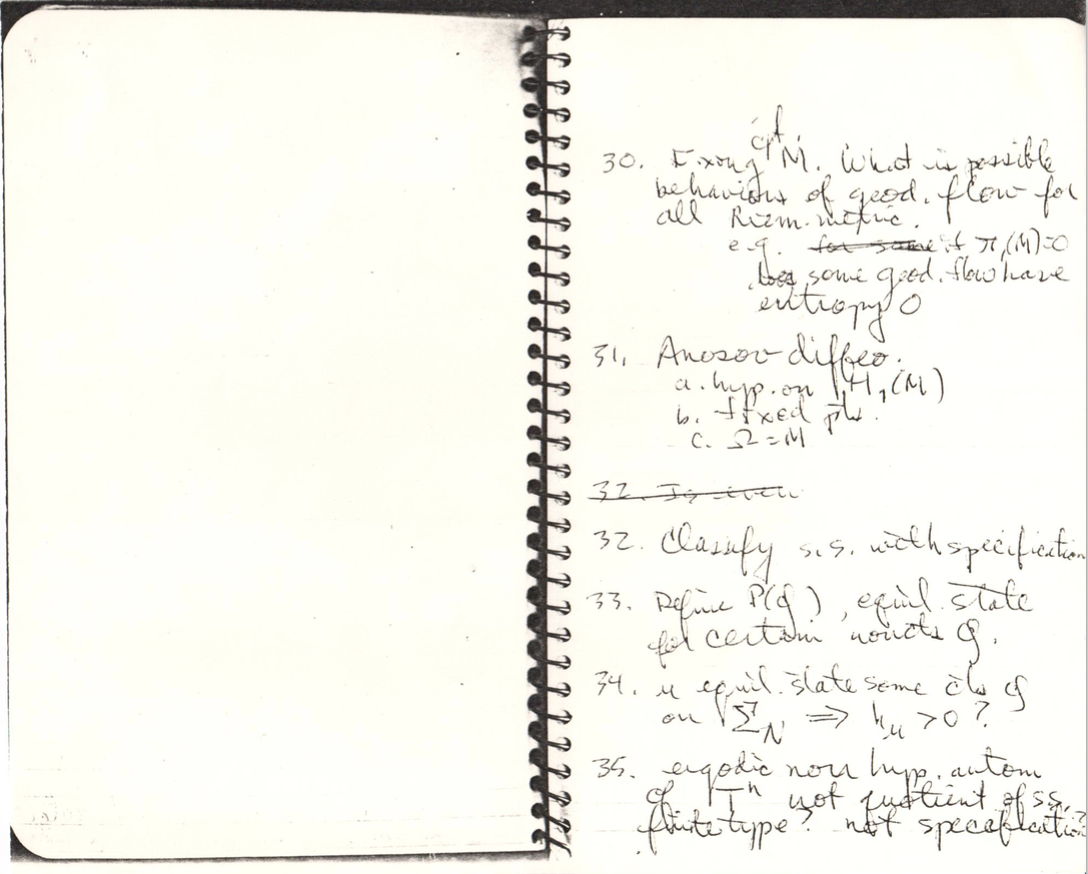
I don’t know that a complete classification is out there, but the following
two papers would seem to answer many or most of the ergodic theory questions
about shifts with specification: 1. Over a finite alphabet, every shift space
with specification is synchronized
[bertrand1986specification]
2.
The ergodic theory of such shifts can be studied using countable state Markov
chains [Klaus Thomsen, “On the ergodic theory of synchronized systems”.
Ergodic Theory Dynam. Systems 26 (2006), no. 4, 1235–1256]. Together these
give some strong results. Bowen’s 1974/75 paper shows that a shift with
specification has a unique MME. Combining 1 and 2 above (and applying results
of Gurevich) one obtains that this MME has exponential decay of correlations.
Similarly for more general equilibrium states (using Sarig’s work for the
Markov chain part), as well as for some non-uniform specification properties
[arXiv:1502.00931].
Comments
See problem 8e
I don’t know that a complete classification is out there, but the following two papers would seem to answer many or most of the ergodic theory questions about shifts with specification: 1. Over a finite alphabet, every shift space with specification is synchronized [bertrand1986specification] 2. The ergodic theory of such shifts can be studied using countable state Markov chains [Klaus Thomsen, “On the ergodic theory of synchronized systems”. Ergodic Theory Dynam. Systems 26 (2006), no. 4, 1235–1256]. Together these give some strong results. Bowen’s 1974/75 paper shows that a shift with specification has a unique MME. Combining 1 and 2 above (and applying results of Gurevich) one obtains that this MME has exponential decay of correlations. Similarly for more general equilibrium states (using Sarig’s work for the Markov chain part), as well as for some non-uniform specification properties [arXiv:1502.00931].