Problem 116
For a subshift $\Sigma _A$, $A$ on stable torus or stable $\mathbb{R}^n$ is an invariant. Describe it invariantly. ($\mathbb{R}^n = ?$, $A = ?$)
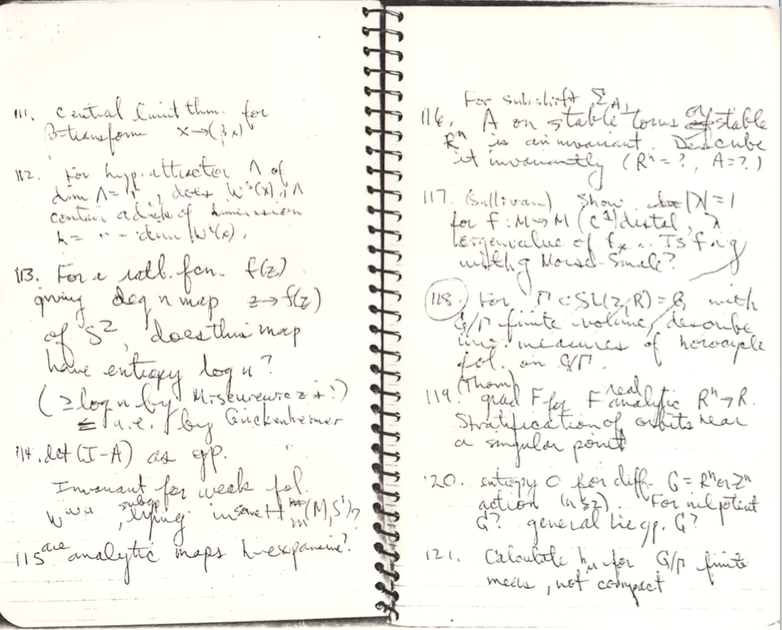
For a subshift $\Sigma _A$, $A$ on stable torus or stable $\mathbb{R}^n$ is an invariant. Describe it invariantly. ($\mathbb{R}^n = ?$, $A = ?$)
Comments
Here $\Sigma_A$ is the shift of finite type defined by a square matrix $A$ with nonnegative integer entries. Let $A$ be $k\times k$. Presumably
stable $\mathbb R^n$'' is the subspace $V$ of $\mathbb R^k$ which is the eventual range of $A$, that is, the intersection of the images of $A^j$ over $j>0$, which equals the image of $A^k$. Restricted to $V$, $A$ is an invertible linear transformation, classified by (for example) the nonnilpotent part of the Jordan form of $A$. This data is a complete invariant of the shift equivalence class of $A$ over $\mathbb R$, hence an invariant of the shift equivalence class of $A$ over $\mathbb Z_+$, hence an invariant of topological conjugacy for the shift of finite type $\Sigma_A$. Krieger's construction of the dimension module (dimension group of $\Sigma_A$ with automorphism induced by the shift) gives a descriptionwhich Bowen might have regarded as a more intrinsic orinvariant’’ description of the shift equivalence class of $A$ over $\mathbb Z_+$. See Sections 7.4, 7.5 of [LindMarcus1995] for more on this, with background and references.