Problem 106
Is the multiplicity of $1$ as an eigenvalue of $A$ a flow conjugacy invariant of $\Sigma _A$? How about $\Pi_{\lambda_i \not = 1} (1- \lambda_i) $?
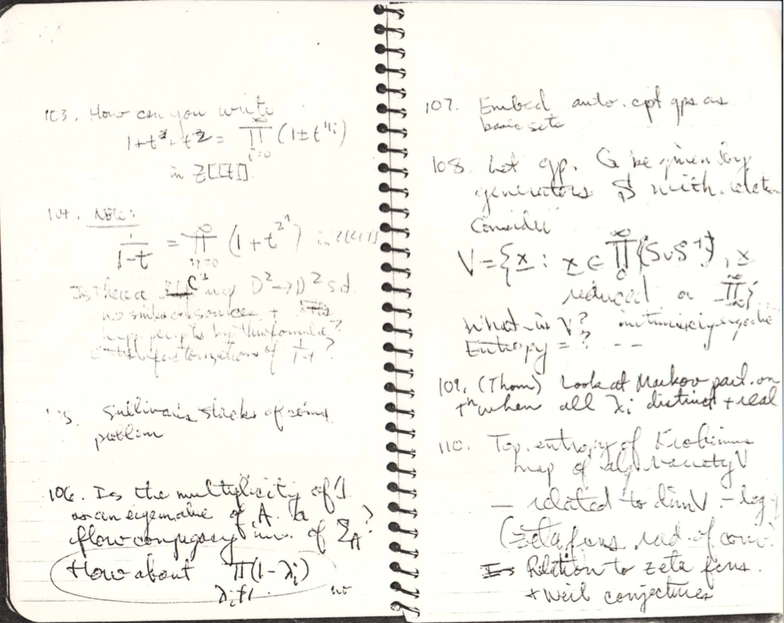
Is the multiplicity of $1$ as an eigenvalue of $A$ a flow conjugacy invariant of $\Sigma _A$? How about $\Pi_{\lambda_i \not = 1} (1- \lambda_i) $?
Comments
Someone (Caroline Series?) wrote “no” near this second question.
I suspect that “flow conjugacy” here is intended to mean “flow equivalence” since otherwise it would be the same as topological conjugacy and det(I -At) is an invariant. For flow equivalence of subshifts of finite type, complete invariants are known. If the shift is irreducible and non-trivial the invariant for flow equivalence is the group BF(A) := Zn/(I-A)Zn together with the integer det(I-A) (see [MR758893] for the final part of the proof and references). The multiplicity of 1 as an eigenvalue of A is the rank of the free part of the group BF(A). So techically the answer to the first question is yes the multiplicity of 1 is an invariant for irreducible SFTs. The fact that BF(A) is an invariant is proved in [bowen1977homology] based on results of Parry and Sullivan. Complete invariants are also known for non-irreducible SFTs, but the answer is more complicated, see [MR1907894] for details and further references.
It certainly wasn’t me. It looks to me like Rufus’ hand and in the same pen as the rest of the problem. Caroline Series
The answer to the second question is indeed no in the case that A has 1 as an eigenvalue. For example, compare $\begin{pmatrix} 2&1\\\2&3 \end{pmatrix}$ and $\begin{pmatrix} 2&1\\\1&2 \end{pmatrix}$. For the first question, note: the multiplicity of 1 as an eigenvalue of A means the dimension of the eigenspace, which can be smaller than the mutliplicity of 1 as a root of the characteristic polynomial of A.