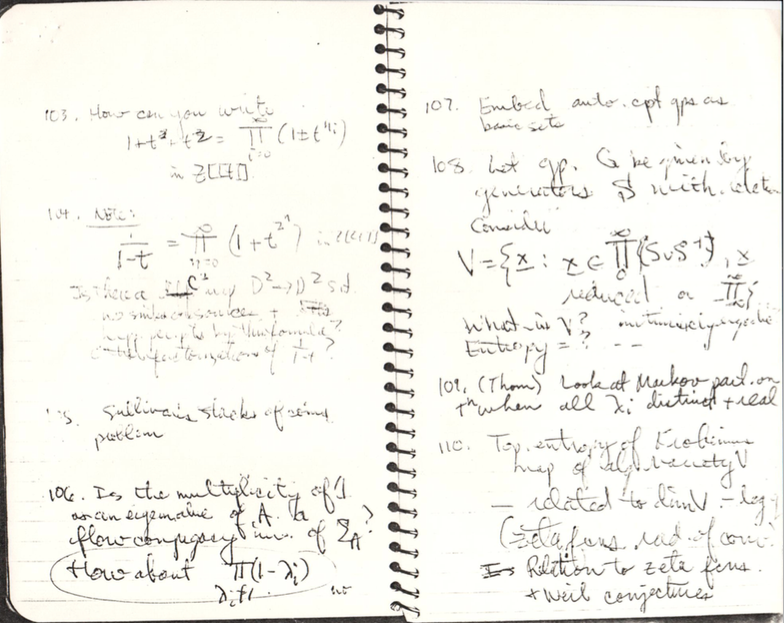
What Rufus calls the false zeta function is is more commonly called the
homology or Lefschetz zeta function. For this the Lefschetz number of $f^n$
instead of the number of fixed points of $f^n$ is used as coefficient in the
formal power series (see
[franks1982homology]
). It is possible that
his interest in $1 + t + t^2$ was because it is the homology zeta function of
the Plykin attractor. An expression of the type he seeks would say that there
is a periodic point of period $n_i$ which either preserves or reverses the
orientation of the unstable manifold according to whether it is $(1- t^{n_i})$
or $(1+ t^{n_i})$. In
[franks1985period]
it is shown that any
formal power series can be expressed essentially uniquely as an infinite
product of the type he mentions. The $n_i$’s and the signs can be solved for
recursively, but he may have wanted a closed form expression.
Comments
What Rufus calls the false zeta function is is more commonly called the homology or Lefschetz zeta function. For this the Lefschetz number of $f^n$ instead of the number of fixed points of $f^n$ is used as coefficient in the formal power series (see [franks1982homology] ). It is possible that his interest in $1 + t + t^2$ was because it is the homology zeta function of the Plykin attractor. An expression of the type he seeks would say that there is a periodic point of period $n_i$ which either preserves or reverses the orientation of the unstable manifold according to whether it is $(1- t^{n_i})$ or $(1+ t^{n_i})$. In [franks1985period] it is shown that any formal power series can be expressed essentially uniquely as an infinite product of the type he mentions. The $n_i$’s and the signs can be solved for recursively, but he may have wanted a closed form expression.